



Introduction: Why the UK Needs Its Own Cost Guide
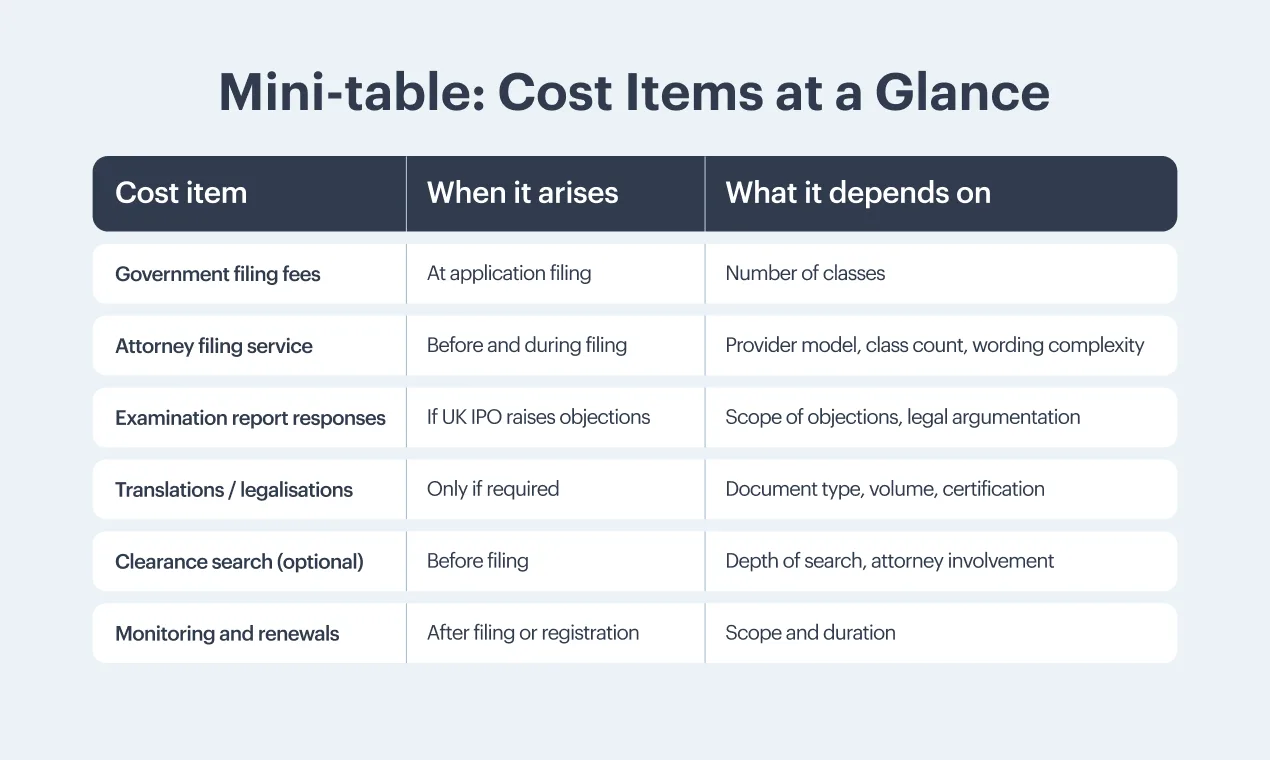
Mini-table: Cost Items at a Glance
What Influences the Total Budget
“UK Budget Traps” and How to Avoid Them
Introduction: Why the UK Needs Its Own Cost Guide
Trademark registration in the United Kingdom is often seen as straightforward, yet the final budget can still exceed initial expectations. This usually happens not because of a single hidden charge, but due to a mix of practical factors:
- government fees increase with every additional class,
- goods and services wording affects examination outcomes,
- examination reports may require professional responses,
- oppositions during publication can add time and cost,
- professional support becomes essential for non-residents or complex filings.
As a result, an early estimate can grow once you refine class scope, respond to UK IPO queries, or involve legal support.
This guide focuses specifically on trademark registration costs in the UK in 2025. Its purpose is to break down every cost component, explain what actually drives the budget, and show how to keep pricing predictable when working with local agents, international firms, or platforms like iPNOTE.
What Forms the Final Cost
Every UK trademark project typically includes four cost blocks.
1. Government fees (UK IPO official fees)
UK government fees are calculated per class, not per item, which makes the structure simpler than in many jurisdictions.
For standard online filings via the UK Intellectual Property Office (UK IPO):
- £170 — online application fee including 1 class
- £50 — for each additional class
Examples:
- 1 class → £170
- 2 classes → £220
- 3 classes → £270
Additional official fees may apply later for administrative actions, such as:
- recordal of name or address changes,
- assignments or ownership transfers.
These are usually charged per request, not per class.
2. Legal services
Using a UK trademark attorney is not mandatory if the applicant has a valid UK, Gibraltar, or Channel Islands address for service. However, professional support is widely used to reduce risk and administrative burden.
Typical legal fees may include:
- preparation and filing of the application (fixed fee or hourly),
- communication with UK IPO,
- drafting or refining goods and services wording,
- monitoring deadlines and forwarding official notices.
Responses to examination reports or oppositions are usually billed per action, depending on complexity.
3. Translations and legalisations
In most cases, translations are not required, as UK trademark proceedings are conducted in English. Costs may arise if:
- corporate documents from non-English jurisdictions need translation,
- ownership changes or assignments require supporting documents,
- non-English brand versions are reviewed for risk assessment.
These costs vary depending on document volume and certification requirements.
4. Optional services
Optional services can improve predictability and reduce downstream costs:
- Pre-filing clearance search
Identifies conflicting marks and reduces the risk of examination reports or oppositions. - Monitoring after filing or registration
Tracks potentially conflicting marks and supports enforcement, adding an ongoing but optional cost.
Mini-table: Cost Items at a Glance
What Influences the Total Budget
Several practical factors shape the final cost.
1. Number of classes and wording scope
Each additional class adds £50 in government fees and often increases professional fees. Overly broad wording can trigger examination reports that require paid responses.
2. Examination reports and oppositions
While UK IPO rarely refuses applications automatically based on earlier rights, objections on absolute grounds or oppositions during publication can increase costs due to legal work and extended timelines.
3. Quality of pre-filing clearance search
A solid clearance search helps avoid:
- obvious conflicts,
- descriptive or weak marks,
- misaligned class coverage.
This often saves money later.
4. Need for translations
Although uncommon, translations can add cost when foreign documents are involved or when additional recordals are required.
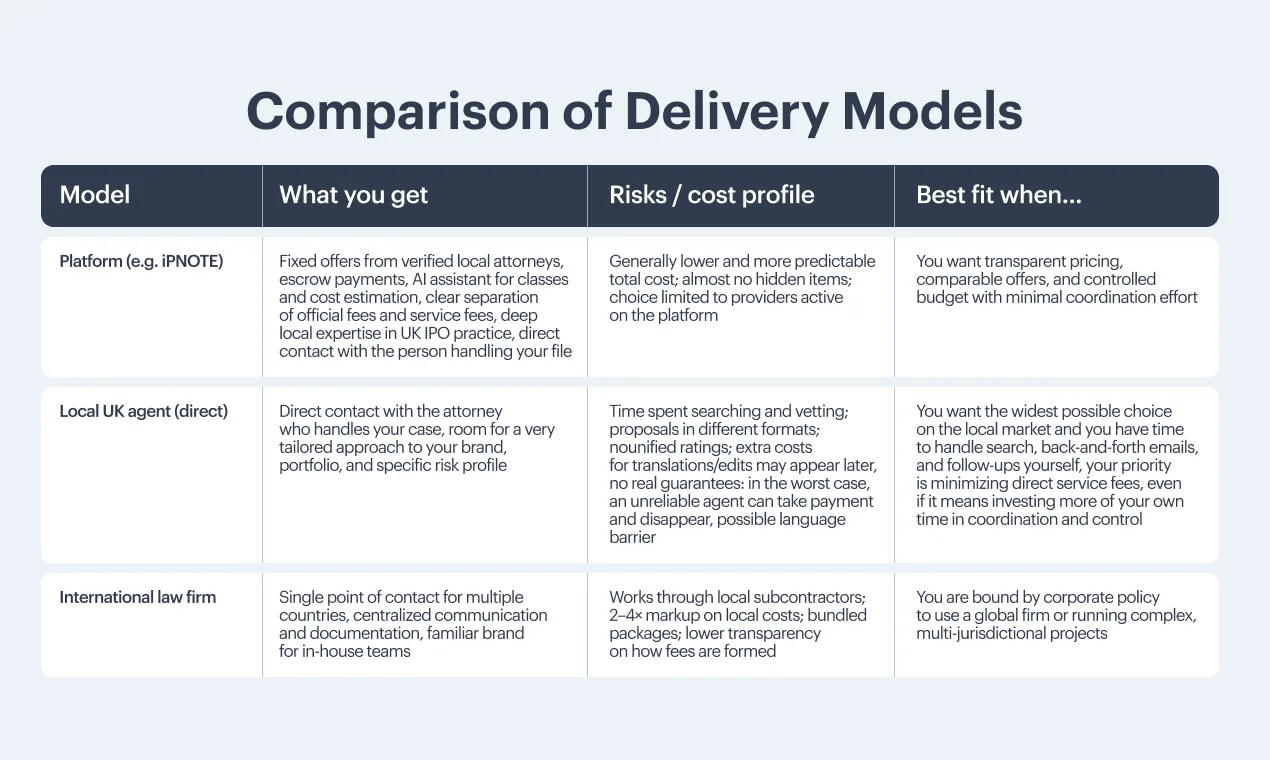
5. Provider type: platform vs local agent vs international law firm
The same filing can have very different cost profiles depending on who manages it:
- local agents may be flexible but inconsistent in pricing,
- international firms often add coordination markups,
- platforms focus on fixed, transparent offers.
Comparison of Delivery Models
“UK Budget Traps” and How to Avoid Them
Several common mistakes push UK trademark budgets beyond the initial plan, even though the UK system is generally transparent.
Trap 1: Overly broad class descriptions
Overly wide or vague wording increases the likelihood of examination reports and paid responses, especially when goods or services are not clearly defined.
How to avoid it: Keep descriptions narrow, precise, and aligned with your real commercial activity to reduce objections and follow-up costs.
Trap 2: Skipping a clearance search
Filing without a prior search raises the risk of examiner objections or oppositions from earlier rights holders, which can significantly increase legal fees later.
How to avoid it: Combine a quick automated search with attorney review to identify conflicts before spending money on filing.
Trap 3: Paying for unnecessary translations
Translations are sometimes included “by default,” even though UK IPO proceedings are conducted in English and translations are rarely mandatory.
How to avoid it: Confirm upfront whether translations are actually required for your specific documents and exclude them from the quote if not needed.
Trap 4: Bundled service packages
All-inclusive bundles may cover monitoring, reports, or administrative actions that are not relevant at the filing stage.
How to avoid it: Request itemised pricing so you pay only for services that directly support registration.
Trap 5: Missed deadlines
Failure to respond to examination reports or opposition deadlines can lead to refusal and force you to refile, doubling government and legal costs.
How to avoid it: Use deadline tracking tools and automatic reminders to keep every stage under control.
Trap 6: No cost breakdown
Without a clear separation of fees, it is difficult to compare offers or understand where additional charges may appear.
How to avoid it: Ask for a transparent split between government fees, legal work, and any extras before approving the budget.
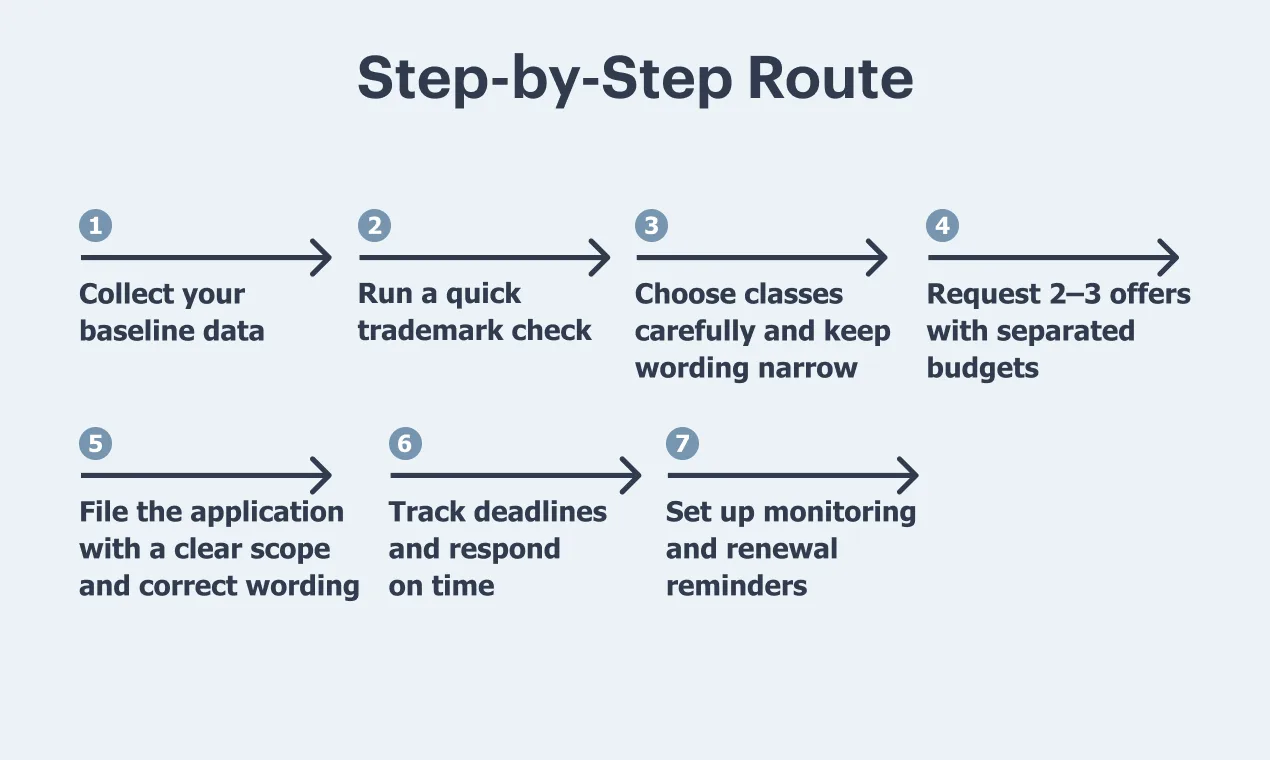
Step-by-Step Route
If you want a detailed procedural walkthrough, you can read our full step-by-step guide to trademark registration in the UK on our blog. Below is a focused summary of the key stages.
1. Collect your baseline data
Gather the essentials: owner details (full legal name, address, legal entity type), a clear representation of the mark (word mark or logo in vector or high-resolution raster format), and a draft list of goods and services reflecting actual and near-term business activity.
2. Run a quick trademark check (UK database + close variants)
Use an AI-assisted check or a basic UK IPO database search to identify obvious conflicts, similar marks, and potentially risky wording before spending on filing fees.
3. Choose classes carefully and keep wording narrow
Select only the Nice classes that match real commercial use. Avoid overly broad or speculative class coverage. Clear, focused wording reduces examination reports, oppositions, and professional fees.
4. Request 2–3 offers with separated budgets
Compare at least one platform-based offer (such as iPNOTE) with direct local agents or a law firm. Always request a clear breakdown: UK IPO fees vs legal services vs optional actions (responses, monitoring).
5. File the application with a clear scope and correct wording
Once a provider is selected, file the application through UK IPO using clean, acceptable descriptions and a realistic class structure. Correct drafting at this stage significantly lowers the risk of objections.
6. Track deadlines and respond on time
Monitor examination timelines, publication dates, and any response deadlines. Late replies or missed actions can lead to refusal and the need to refile, increasing total cost.
7. Set up monitoring and renewal reminders
After registration, enable monitoring for conflicting marks and configure renewal reminders. UK trademarks are valid for 10 years from the filing date and must be renewed on time to maintain protection.
FAQ: Short, Practical Answers
Q1: Can foreigners file a trademark in the UK without a local agent?
Yes, but only if they provide a valid address for service in the UK, Gibraltar, or the Channel Islands. UK IPO requires every application to have a local address for official correspondence.
Q2: Are translations always required?
No. UK proceedings are in English. Translations are needed only in specific document-related situations.
Q3: How long does trademark registration take in the UK?
If there are no objections or oppositions, registration typically takes around 4 months from the filing date. Oppositions or objections extend timelines.
Q4: What happens after registration?
After registration, UK IPO issues an electronic registration certificate and records the mark in the UK trademark register. The trademark is valid for 10 years from the filing date. To keep protection, it must be renewed every 10 years by paying the renewal fee.
Conclusion
Trademark registration costs in the UK become manageable once the structure is clear: fixed government fees per class, professional services where they add value, and optional costs that arise only in specific scenarios. Transparency removes uncertainty.
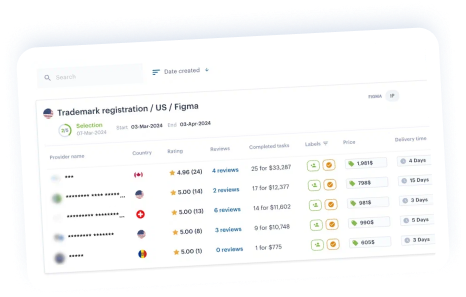
With iPNOTE, you can upload your trademark details, receive AI-assisted class suggestions, and compare fixed, itemised offers from verified UK attorneys. You see the full cost picture before committing.
If you want predictable pricing, clear timelines, and ongoing control in one place, create a UK filing task on iPNOTE and see exactly what your trademark registration will cost end-to-end.