





In today’s knowledge-driven economy, protecting intellectual property (IP) is not a luxury, it’s a necessity. For businesses, startups, and inventors, IP can be a critical asset that ensures competitiveness, attracts investors, and provides a legal edge in the market.
Yet, many hesitate to protect their ideas due to uncertainty:
- Lack of awareness about available options
- Fear of high costs and legal complexity
- Doubts about the practical benefits
This article will guide you through the main types of IP protection and help you decide which strategy best fits your goals.
Content
1. Main Forms of IP Protection
3. When a Trademark or Industrial Design Is Enough
4. Before You File for a Patent
6. Conclusion: Don’t Delay — Protect Smart
Main Forms of IP Protection
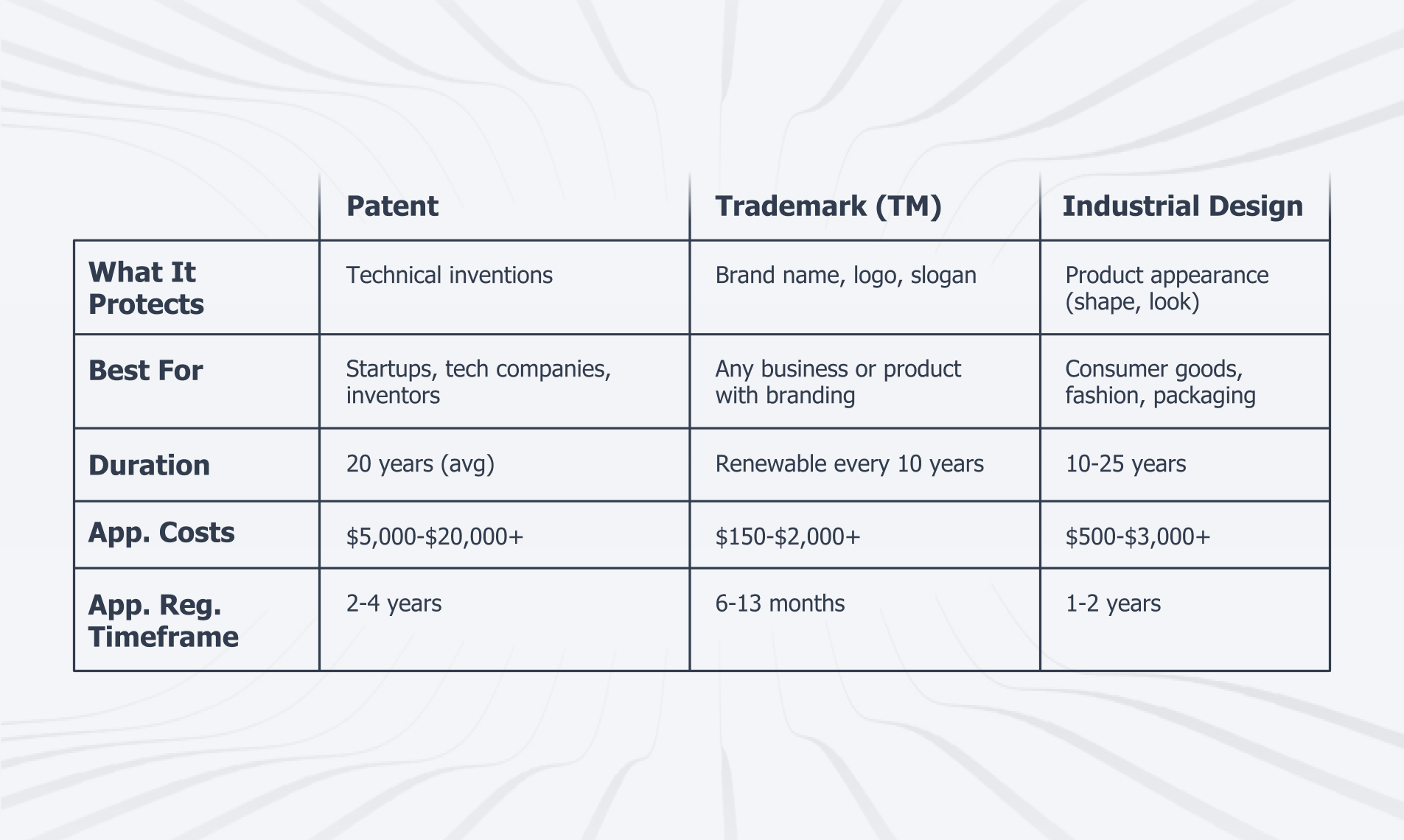
There are several ways to protect your intellectual assets. The most common are:
- Patent: Protects technical inventions such as devices, methods, or processes.
- Trademark (TM): Protects brand identity — names, logos, slogans.
- Industrial Design: Protects the visual appearance of a product.
When Do You Need a Patent?
A patent is essential when your product or idea involves a technical solution that is:
- New (not previously disclosed)
- Inventive (not obvious to others in the field)
- Industrial applicable (can be used in practice)
Examples:
- A new medical device
- An AI-powered algorithm
- A unique method for recycling materials
You likely need a patent if:
- You plan to license or sell the technology
- You are raising investment and need to prove IP ownership
- You are participating in tenders or grants that require protected tech
Common myths:
- You cannot patent an “idea” without a working solution
- Abstract concepts, business models, or natural phenomena are usually not patentable
When a Trademark or Industrial Design Is Enough
Not every innovation requires a patent. Sometimes, a TM or design registration can fully meet your goals, and do so faster and cheaper.
Trademark (TM) protects your brand identity:
- Business or product name
- Logo
- Tagline or slogan
Use case: A food startup launching a new energy drink might not have a unique recipe to patent but should protect the name and logo to prevent copycats.
Industrial Design protects the external appearance of products:
- Product shape
- User interface layout
- Packaging design
Use case: A fashion brand with a distinctive bag shape or a startup with a unique device casing can protect their designs even without a patent.
Getting a patent is a strategic decision. Before applying:
- Check novelty: Has anyone already published or patented a similar invention? A patent search is essential. Use iPNOTE AI patent search tool to conduct a patent search for free.
- Assess risks and costs: Filing and maintaining a patent involves expenses and time — be realistic about your capacity and goals.
- Consider mixed strategies: You can combine a patent + trademark + design for stronger protection.
Many first-time applicants fall into these traps:
- Believing a patent is always the best solution
- Delaying protection until it’s too late (e.g. after public disclosure)
- Filing a patent application without checking if it’s patentable or already exists
- Underestimating the value of simpler tools like trademarks or designs
Conclusion: Don’t Delay — Protect Smart
Choosing the right IP protection is not about filing as much as possible — it’s about being strategic. Whether it’s a patent for your technology, a trademark for your brand, or a design registration for your product look — act early and choose wisely.
Start now: Get a free patentability check or begin your patent application today.
Let your innovations work for you — not for your competitors.