



Introduction: Why Thailand Needs Its Own Cost Guide
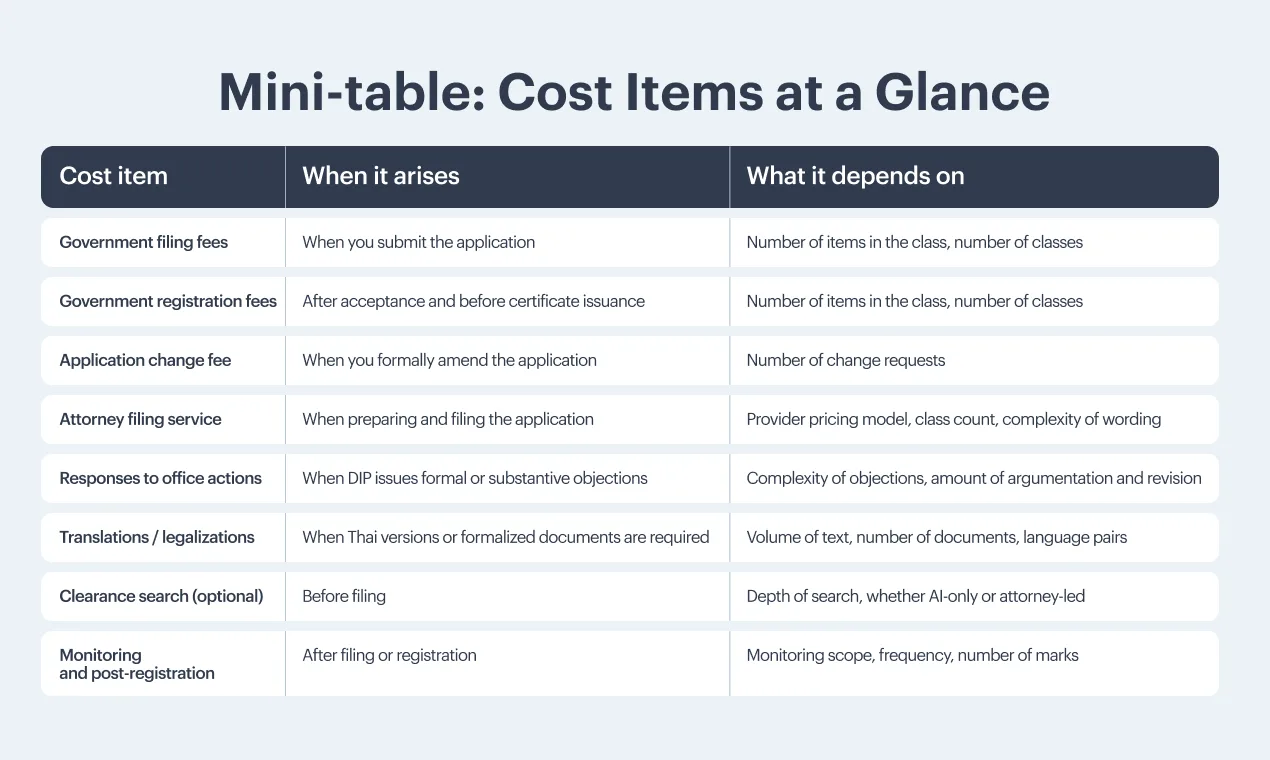
Mini-table: Cost Items at a Glance
What Influences the Total Budget
“Thai Budget Traps” and How to Avoid Them
Introduction: Why Thailand Needs Its Own Cost Guide
Trademark registration in Thailand looks simple on paper, but the budget often turns out higher than expected. The reason is not one single “hidden fee”, but a combination of local rules:
- Government fees are calculated per item, not per class.
- Thailand allows only one class per application.
- The Department of Intellectual Property (DIP) applies strict distinctiveness and wording standards.
- Many steps still rely on manual internal processing, which affects time and cost.
As a result, the initial “rough estimate” grows as you add items, adjust descriptions, handle office actions, pay for translations, or ask an attorney to fix issues with DIP.
This guide focuses specifically on trademark registration costs in Thailand in 2025. The goal is to make all expense categories clear, show what actually drives the budget, and explain how to keep costs predictable when working with local agents, international firms, or platforms like iPNOTE.
What Forms the Final Cost
Every trademark project in Thailand typically includes four cost blocks:
1. Government fees (DIP official fees)
Thailand calculates official fees per item in each class, not per class as a whole.
From the source:
- Filing – Application for Registration of a Trademark
- 1–5 items in a class → 1,000 THB per item (~27 USD)
- More than 5 items → 9,000 THB per additional item (~243 USD)
- Application for changes in a trademark application
- 200 THB per request (~5.4 USD)
- Registration fees
- 1–5 items → 600 THB per item (~16 USD)
- More than 5 items → 5,400 THB per additional item (~146 USD)
This is why a class with 10 separate items can reach 50,000 THB (~1,351 USD) in government fees, while a compact class with 5 items costs only 5,000 THB (~135 USD).
2. Legal services
For foreign applicants, using a Thai trademark attorney is mandatory. The source indicates that a typical fee is:
- ≈ 350 USD per class (average)
This usually covers:
- Preparing and filing the application
- Communicating with DIP
- Drafting and adjusting goods/services wording to DIP standards
- Monitoring deadlines
- Receiving DIP notices
- Submitting basic corrections
More complex actions (detailed arguments, appeals, extensive strategy work) are usually billed separately.
3. Translations and legalizations
Translations and legalizations may be required when:
- The Power of Attorney needs to be in Thai
- Corporate documents require Thai versions for verification
- The goods/services list must be localized into DIP-approved wording
- DIP requests clarifications or additional explanations in Thai
These costs are not fixed in the source, but the important point is this: every unnecessary correction or rewrite can trigger additional translation and attorney time, which pushes the budget up.
4. Optional services
Optional, but often very useful:
- Advanced clearance search before filing
A professional search by a Thai attorney that looks beyond obvious matches and covers Thai transliterations, phonetic equivalents, conceptual similarity and DIP practice. It reduces the risk of office actions and refusals, which saves money later. - Collision monitoring after filing / registration
Ongoing monitoring for new conflicting filings in Thailand. This helps enforce rights and react early, but adds a separate ongoing cost.
Mini-table: Cost Items at a Glance
What Influences the Total Budget
The final number is shaped by several practical factors.
1. Number of classes and items
Thailand uses single-class applications and per-item fees. That means:
- Each additional class requires a new application and new set of fees.
- Each extra item inside a class can multiply official fees, especially beyond the first five.
2. Office actions and oppositions
Every office action (formal or substantive) adds:
- Attorney time for analysis and drafting a response
- Possible translations
- Additional waiting time in the DIP queue
3. Quality of pre-filing clearance search
A good clearance search (AI-based plus review by a Thai attorney) reduces the risk of:
- Filing a mark that clearly conflicts with an existing one
- Descriptive or weak marks that will draw objections
- Misaligned classes or goods/services wording
4. Need for translations
Where translations are required (Power of Attorney, goods/services list, supporting documents), the cost depends on:
- Volume of text
- Number of documents
- Whether there are multiple rounds of corrections
5. Provider type: platform vs local agent vs international law firm
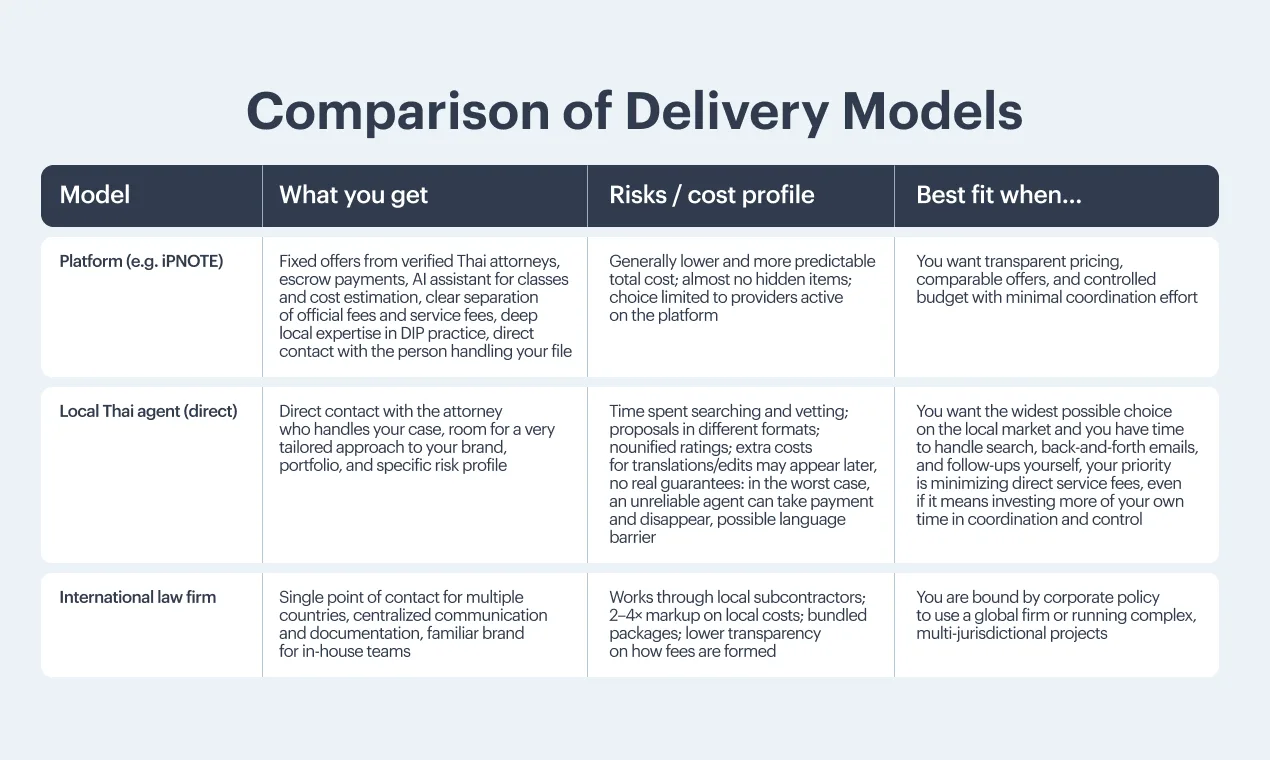
The same trademark project can have very different cost structures depending on who coordinates it:
-
- A local agent may offer lean pricing, but budgets are not always structured or comparable.
- An international law firm often adds coordination markups on top of local agent costs.
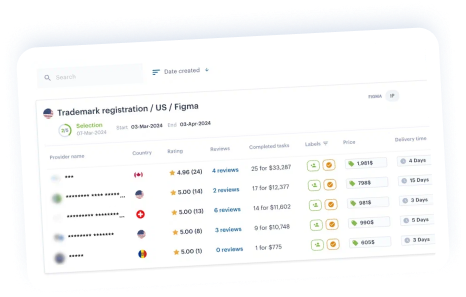
- A platform like iPNOTE focuses on fixed offers and transparent breakdowns, which makes comparison and planning easier.
Comparison of Delivery Models
“Thai Budget Traps” and How to Avoid Them
Several typical mistakes push Thai trademark budgets far beyond the initial plan.
Trap 1: Overly broad class descriptions
Wide lists of goods and services lead to:
- Many items per class → very high official fees
- More room for DIP to object to unclear or descriptive wording
How to avoid it:
Focus on the goods and services that actually matter for your business. Combine related items into one where acceptable, and keep wording precise and DIP-friendly.
Trap 2: No clearance search
Skipping a clearance search increases the risk of:
- Filing a mark that conflicts with an existing one
- Receiving substantive office actions
- Paying again for a new application after refusal
How to avoid it:
Use a two-step approach:
- AI-based instant risk check through a platform.
- Manual search by a Thai trademark attorney for deeper risks (transliterations, phonetics, conceptual similarity).
Trap 3: Automatic or generic translations
Goods and services translated automatically or copied from other jurisdictions may:
- Fail to meet DIP wording expectations
- Require multiple rounds of correction
- Trigger office actions and extra translation/attorney costs
How to avoid it:
Rely on local attorneys and platform tools that already use DIP-approved terminology and structure. Aim to “get it right” in the first submission.
Trap 4: Bundled packages without relevance
Some service packs include:
- Broad monitoring
- Multi-country add-ons
- Extra reporting layers
These elements can be useful, but they also increase cost when not strictly necessary for your current goals.
How to avoid it:
Start from what you truly need: registration in Thailand with clear, predictable maintenance. Add extra services only where they support a defined strategy.
Trap 5: Deadline and timezone issues
Thailand has:
- Strict deadlines for responses to formal and substantive office actions
- A defined 90-day opposition period after publication
Missing a deadline can lead to abandonment or refusal, which means starting (and paying) again.
How to avoid it:
Use tools that:
- store all deadlines in one place,
- send automatic reminders,
- keep status visible on a dashboard (for example, the IP Rights card on iPNOTE).
Trap 6: Proposals without cost breakdown
A single “all-inclusive” fee makes it hard to understand:
- How much goes to DIP
- How much is attorney time
- How much covers translations, corrections or extras
How to avoid it:
Ask for a breakdown into:
-
- Government fees
- Legal services
- Translations and additional work
Platforms that structure offers this way make comparison and approval much easier.
Step-by-Step Route
If you want a detailed procedural walkthrough, you can read our full step-by-step guide to trademark registration in Thailand in our blog. Below is a focused summary of the key stages.
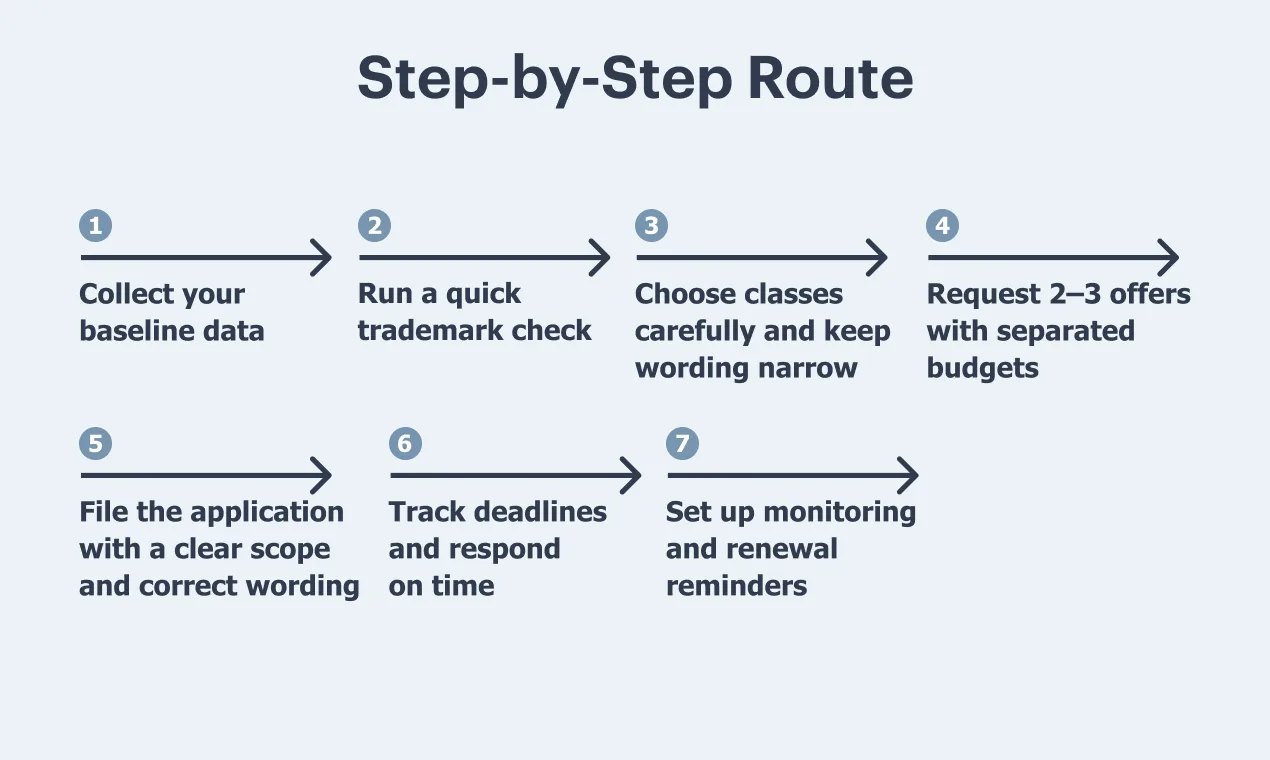
- Collect your baseline data
Gather the essentials: owner details (name, address, entity type), a clear representation of the mark (word mark or logo in vector/raster format), and a draft list of goods and services. - Run a quick trademark check (Thailand + transliterations)
Use an AI-assisted check or a basic search to spot obvious conflicts and risky names, including Thai transliterations and close phonetic variants. - Choose classes carefully and keep wording narrow
Select only the classes that match your real business activity and keep the list of items focused. Fewer, well-chosen items mean lower official fees and fewer chances of objections. - Request 2–3 offers with separated budgets
Compare at least one platform offer (like iPNOTE) with direct local agents or a law firm. Always ask for a breakdown: official fees vs legal work vs translations vs optional services. - File the application with a clear scope and correct wording
Once you choose a provider, file with DIP using clean, DIP-approved descriptions and a realistic class structure to reduce the risk of office actions. - Track deadlines and respond on time
Monitor formal and substantive examination deadlines, publication windows, and payment dates. Late responses and missed payments almost always increase total cost. - Set up monitoring and renewal reminders
After registration, enable monitoring for conflicting marks and configure renewal reminders. This protects your investment and prevents expensive recovery actions later.
FAQ: Short, Practical Answers
Q1: Can foreigners file a trademark in Thailand without a local agent?
No. According to the process described, foreign applicants must appoint a licensed Thai trademark attorney. Filing directly with DIP without a local representative is not allowed.
Q2: Are translations always required?
Not always, but they may be required for Power of Attorney / Corporate documents / Additional clarifications requested by DIP. The need for translations depends on your starting documents and the attorney’s strategy.
Q3: How long does trademark registration take in Thailand?
Typical total: 12–24 months, and up to 30 months if office actions arise.
Q4: What happens after registration?
Once registration is complete, DIP issues the Trademark Registration Certificate.The trademark remains valid for 10 years from the filing date, and then must be renewed to keep protection.
Conclusion
Budgeting for trademark registration in Thailand becomes much easier when you see the full structure: per-item government fees, attorney services, translations, and the impact of office actions, timelines, and class strategy. The numbers stop looking random once each expense has a clear place and reason.
With iPNOTE, you can upload your trademark data, let the AI assistant suggest classes and estimate costs, and then receive fixed, itemized offers from verified Thai attorneys.
If you want predictable pricing, clear timelines, and ongoing monitoring in one place, create a full-service filing task for Thailand on iPNOTE and see exactly what your trademark registration will cost before you commit.