



Introduction: Why South Korea Needs Its Own Cost Guide
What Influences the Total Budget
“Korean Budget Traps” and How to Avoid Them
Introduction: Why South Korea Needs Its Own Cost Guide
Trademark registration in South Korea is often perceived as straightforward, especially compared to jurisdictions with item-based or paper-heavy systems. In practice, however, applicants frequently face budget uncertainty. The issue is rarely a single “hidden fee”, but a combination of structural factors specific to the Korean system:
- government fees are calculated per class and per number of goods/services within each class,
- additional fees apply once you exceed standard item thresholds,
- responses to examination requests are common and add professional costs,
- translations and formal documents may be required for non-residents,
- pricing varies widely depending on whether you work with a local agent, an international firm, or a platform.
As a result, an initial estimate can grow once the application enters examination, requires clarification, or triggers additional service work.
This guide focuses specifically on trademark registration costs in South Korea in 2025. Its purpose is to break down every cost component, explain what truly drives the final price, and show how to keep expenses predictable when working with local agents, international law firms, or platforms like iPNOTE.
What Forms the Final Cost
Every trademark project in South Korea is built from several core cost blocks. Understanding each of them upfront is the key to avoiding budget surprises.
1. Government fees (KIPO official fees)
South Korea calculates official fees per class, with surcharges once the number of goods/services in a class exceeds 10. The system is transparent, but the structure matters.
Application Fee (filing stage)
- 52,000 KRW per class (up to 10 goods/services)
- +2,000 KRW for each good/service beyond 10
This fee is mandatory and must be paid at filing; without it, the application is not accepted.
Examination Fee (substantive examination)
- 18,000 KRW per class (online filing)
This fee can be:
- paid together with the application fee (most common), or
- paid later, before substantive examination begins.
If it has not been paid by the time KIPO is ready to examine the mark, KIPO issues a formal Request for Examination Fee Payment, and examination does not start until payment is made.
Registration Fee (after approval)
- 201,000 KRW per class (base rate, up to 10 goods/services)
- +2,000 KRW for each good/service beyond 10
Because both the application and registration fees increase when goods exceed 10 items, overly broad descriptions directly affect government costs.
2. Legal services
For foreign applicants, appointing a Korean trademark agent is mandatory. Legal service fees vary depending on scope and pricing model, but typically include:
- preparation and filing of the application,
- correspondence with KIPO,
- monitoring deadlines and status updates,
- handling routine formalities.
A common market benchmark is around USD 500 per class for a basic “file-and-monitor” service.
More complex work is usually charged separately, for example:
- responses to formal or substantive examination requests (often priced per action),
- arguments on distinctiveness or similarity,
- handling oppositions.
3. Translations and legalizations
Translations are not always required, but they may become necessary when:
- a Power of Attorney must be prepared in Korean,
- corporate documents need Korean versions,
- KIPO requests clarifications or explanations in Korean.
These costs depend on document volume and complexity. Importantly, poorly prepared filings often lead to extra translation rounds, increasing both translation and attorney fees.
4. Optional services
Optional services are not mandatory, but often cost-effective in practice:
- Pre-filing clearance search
A professional search reduces the risk of Office Actions and refusals, which are far more expensive than a search. - Post-filing monitoring
What Influences the Total Budget
Several practical factors determine the final number on your invoice.
1. Number of classes and goods/services
South Korea allows multi-class applications, but fees are still calculated per class. In addition:
- exceeding 10 goods/services per class increases both application and registration fees,
- wide class descriptions often trigger examination requests.
2. Office Actions and oppositions
Every Office Action adds:
- professional drafting time,
- possible translations,
- delay in the overall timeline.
3. Quality of the clearance search
A solid pre-filing search lowers the risk of:
- conflicts with earlier marks
- descriptiveness objections
- costly refilings
4. Translation requirements
Costs increase with:
- the number of documents,
- repeated revisions,
- late-stage corrections.
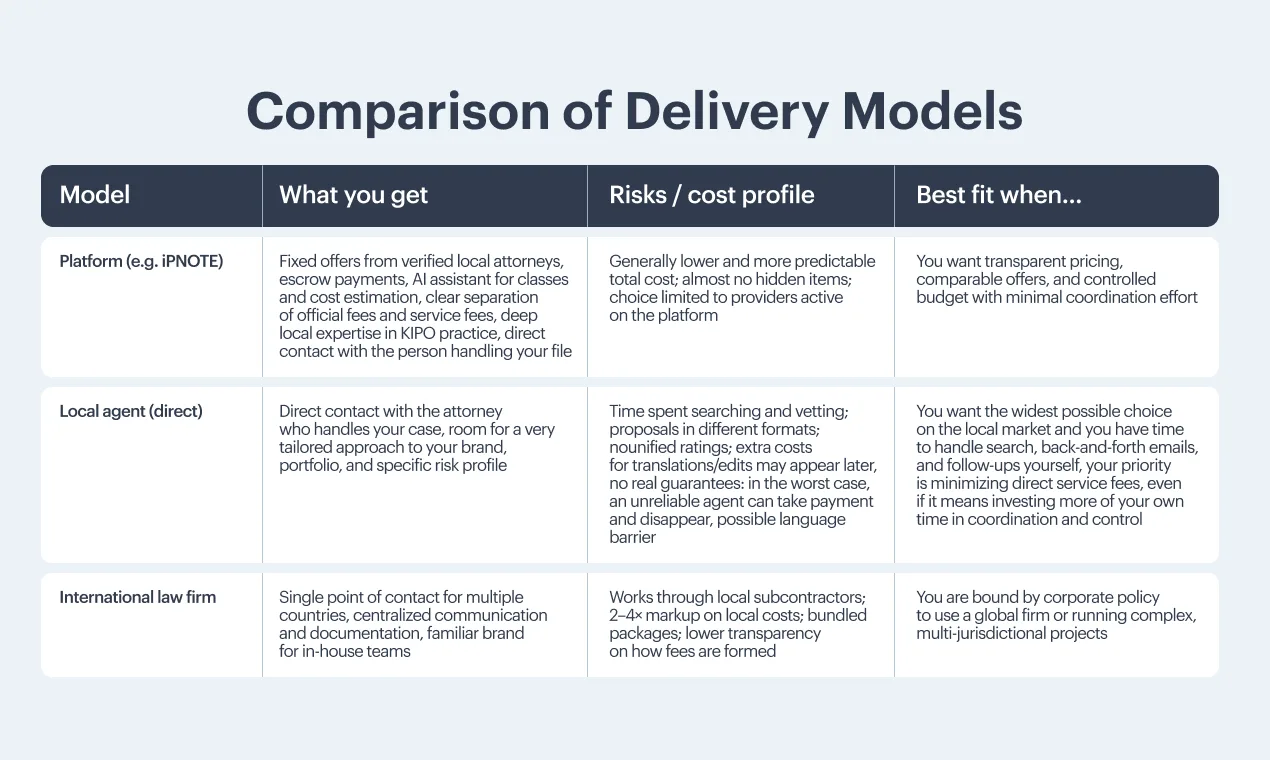
3.5 Provider type
The same filing can cost very differently depending on who manages it:
-
- a local agent,
- a global law firm,
- or a platform with fixed offers.
Comparison of Delivery Models
“Korean Budget Traps” and How to Avoid Them
Several recurring issues tend to inflate trademark budgets in South Korea.
Trap 1: Overly broad class descriptions
Broad wording leads to:
- higher risk of office actions,
- more amendments,
- and additional legal fees.
How to avoid it:
Use narrow, relevant descriptions aligned with actual commercial use.
Trap 2: No clearance search before filing
Skipping clearance increases the likelihood of:
- office actions,
- refusals,
- or the need to refile.
How to avoid it:
Run a quick clearance check before filing to identify obvious risks early.
Trap 3: Automatic or default translations
Unnecessary or excessive translations result in:
- avoidable expenses,
- repeated revisions.
How to avoid it:
Clarify in advance whether translations are required and for which documents.
Trap 4: Non-separable service packages
Bundled offers may include services that are not needed for a specific case.
How to avoid it:
Request a breakdown into:
- government fees,
- legal work,
- translations,
- and conditions for additional office action responses.
Trap 5: Deadlines and time zone issues
Missed deadlines can lead to:
- penalties,
- loss of rights,
- or restarting the process.
How to avoid it:
Use a system with a unified deadline calendar and automatic reminders.
Trap 6: Proposals without detailed estimates
Single-line pricing hides:
- how fees are allocated,
- what triggers additional charges.
How to avoid it:
Require itemized estimates and clear per-action conditions for future responses.
Step-by-Step Route
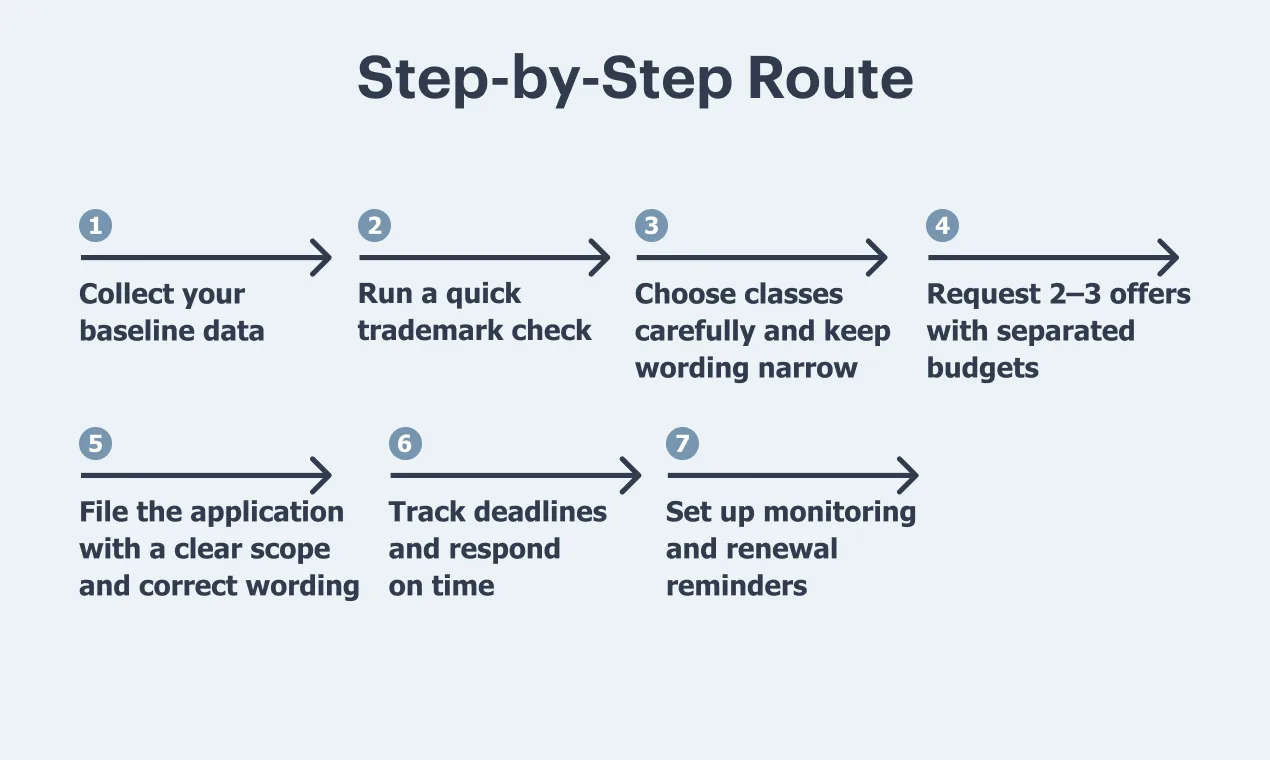
If you want a detailed procedural walkthrough, you can read our full step-by-step guide to trademark registration in South Korea in our blog. Below is a focused summary of the key stages.
1. Collect your baseline data
Gather the essentials: owner details (name, address), a clear representation of the mark (word mark or logo in vector/raster format), a draft list of goods and services, and priority details if applicable.
2. Run a quick trademark check (Korea + transliterations)
Use an AI-assisted check or a basic database search to identify obvious conflicts, similar marks, phonetic variants, and risks related to descriptive wording.
3. Choose classes carefully and keep wording narrow
Select only the classes that reflect your real business activity and keep goods/services descriptions precise. Narrow wording reduces the risk of Office Actions and additional service costs.
4. Request 2–3 offers with separated budgets
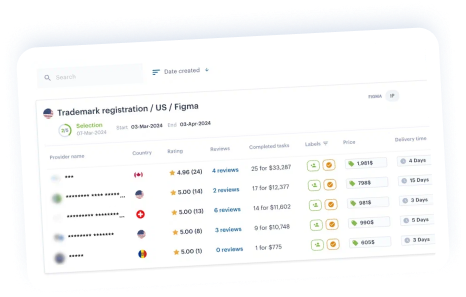
Compare at least one platform offer (such as iPNOTE) with local Korean agents. Always request a clear breakdown: government fees, legal services, per-action responses, and translations if required.
5. File the application with a local representative (if required)
Non-resident applicants must file through a Korean trademark agent. Confirm the final wording and class structure before filing to avoid later amendments.
6. Track deadlines and respond on time
Monitor formalities, substantive examination deadlines, and payment notices. Late responses or missed payments can lead to refusal or extra costs.
7. Plan registration, monitoring, and renewal
After registration, enable monitoring for conflicting marks and set renewal reminders. In Korea, trademarks are valid for 10 years and must be renewed on time to maintain protection.
FAQ
Q1: Can foreigners file a trademark in South Korea without a local agent?
No. If the applicant does not have a domicile or residence in South Korea, Korean trademark law requires the appointment of a licensed Korean patent attorney or trademark agent. Non-residents cannot independently file or prosecute a trademark application before KIPO.
Q2: Are translations always required?
KIPO procedures are conducted in Korean. If the applicant’s documents (such as corporate details or supporting materials) are not originally in Korean, a Korean translation is required.
In practice, translations are often prepared by the local agent and may either be included in the filing service or charged separately, depending on the provider’s scope of work.
Q3: What government fees should I expect in 2025?
KIPO charges official fees for:
- filing the application (Application Fee),
- substantive examination (Examination Fee),
- registration (Registration Fee).
Q4: How long does trademark registration take in South Korea?
There is no fixed statutory duration for trademark registration in South Korea.
In practice, a standard application without Office Actions or oppositions is typically registered in approximately 10–12 months.
Cases involving objections or disputes can extend well beyond the typical timeframe.
Q5: What happens after registration?
A registered Korean trademark is valid for 10 years from the registration date, not from the filing date. The registration can be renewed for consecutive 10-year periods upon payment of renewal fees.
Conclusion
Trademark registration costs in South Korea are predictable once the structure is clear: class-based government fees, professional services, and optional work that appears only in specific situations. Most budget overruns come from broad class wording, lack of pre-filing searches, or unclear service scopes.
Using a platform like iPNOTE allows you to see fixed offers in advance, compare providers, and separate official fees from professional work. This transparency helps you control costs, avoid unnecessary extras, and move through the Korean system with confidence.
Create a task, upload your trademark data, and receive a clear, itemized cost calculation for South Korea, before you commit.