



Introduction: A Clear Path to Trademark Registration in the UK
Trademark Registration Process in the UK: Overview
Budget: What Trademark Registration Costs in the UK
Timeline: How Long Trademark Registration Takes in the UK
Introduction: A Clear Path to Trademark Registration in the UK
Registering a trademark in the United Kingdom looks straightforward on the surface, yet the real budget often turns out higher than the first quote. The issue usually comes from details that are easy to overlook:
- government fees grow with every extra class,
- wording of goods and services needs careful drafting,
- examination reports may require a reply from an attorney,
- translations or additional documents sometimes appear mid-process,
- oppositions during publication can add time and cost.
For many applicants, this creates familiar worries: What will the final amount be? Are there hidden fees? Am I paying for services I don’t really need?
This guide explains the full process of UK trademark registration in 2025 from search to certificate and shows how to keep both the procedure and the budget under control. You’ll see which costs are fixed, where additional expenses appear, and how a platform model (such as iPNOTE) helps you work with verified local representatives on transparent terms.
What Can Be Registered as a Trademark in the UK?
The UK follows the Trade Marks Act 1994 and allows a wide range of signs to be registered with the UK Intellectual Property Office (UK IPO). You can register:
- word marks (brand names, slogans),
- logos and graphic elements,
- combination marks (word + logo),
- shapes,
- colours or colour combinations,
- sounds,
- any combination of the above, as long as the sign can be represented clearly and precisely and can distinguish your goods or services from those of others.
The key requirement is distinctiveness. Generic or purely descriptive wording such as “Fresh Bread” for a bakery or “Best Quality Tools” for tools is likely to face objections during examination.
Grounds for Refusal in the UK: What Can Cause Problems?
UK IPO examines every application on absolute grounds and also checks for earlier rights on relative grounds.
Absolute grounds
A mark may be refused if it:
- is descriptive of the kind, quality, quantity, purpose, value or geographical origin of the goods/services,
- is customary in the trade,
- lacks distinctive character,
- misleads the public (for example about nature, quality, or geographical origin),
- is contrary to public policy or accepted principles of morality,
- contains protected state symbols (flags, emblems, royal arms) without the required consent,
- cannot function as a “sign” capable of graphical representation in the legal sense.
Relative grounds
UK IPO searches for earlier UK and comparable rights and lists possible conflicts in the examination report, but does not normally refuse an application automatically because of earlier marks. Owners of those earlier marks must decide whether to oppose the application during publication.
This system is more flexible than automatic refusals, but it means that risk can reappear later in the process at the opposition stage. A thorough clearance search before filing greatly reduces this risk.
Language, Address for Service and Local Requirements
Language and localization
- Applications are filed in English.
- Goods and services must follow the Nice Classification and use clear, specific wording that UK IPO considers acceptable. Overly broad phrases increase the chance of an examination report.
There is no requirement to file translations or transliterations of the mark itself unless you want to protect a particular version (for example, an Arabic or Chinese version of the brand).
Address for service
Every UK trade mark application must have an address for service in the UK, Gibraltar or the Channel Islands. This address is where UK IPO sends all official communications.
- UK or EEA businesses usually use their own UK office address or that of their attorney.
- Overseas applicants without such an address must appoint a UK representative (for example, a trademark attorney or IP firm) to act as their address for service.
This requirement is formal, but it has cost consequences: non-residents who file without a professional representative still need a local address and must handle UK IPO correspondence themselves.
Territoriality and the First-to-File Principle
UK trademark rights are territorial:
- protection in the UK covers England, Scotland, Wales and Northern Ireland only;
- registration in the EU, US or any other country does not provide protection in the UK;
- a separate UK application or designation is required.
The UK system works essentially on a first-to-file basis. Earlier registered or pending marks carry strong rights and can be used to oppose later applications. For businesses entering the UK market, this makes early filing critical, ideally before launch or before appointing local distributors.
Trademark Registration Process in the UK: Overview
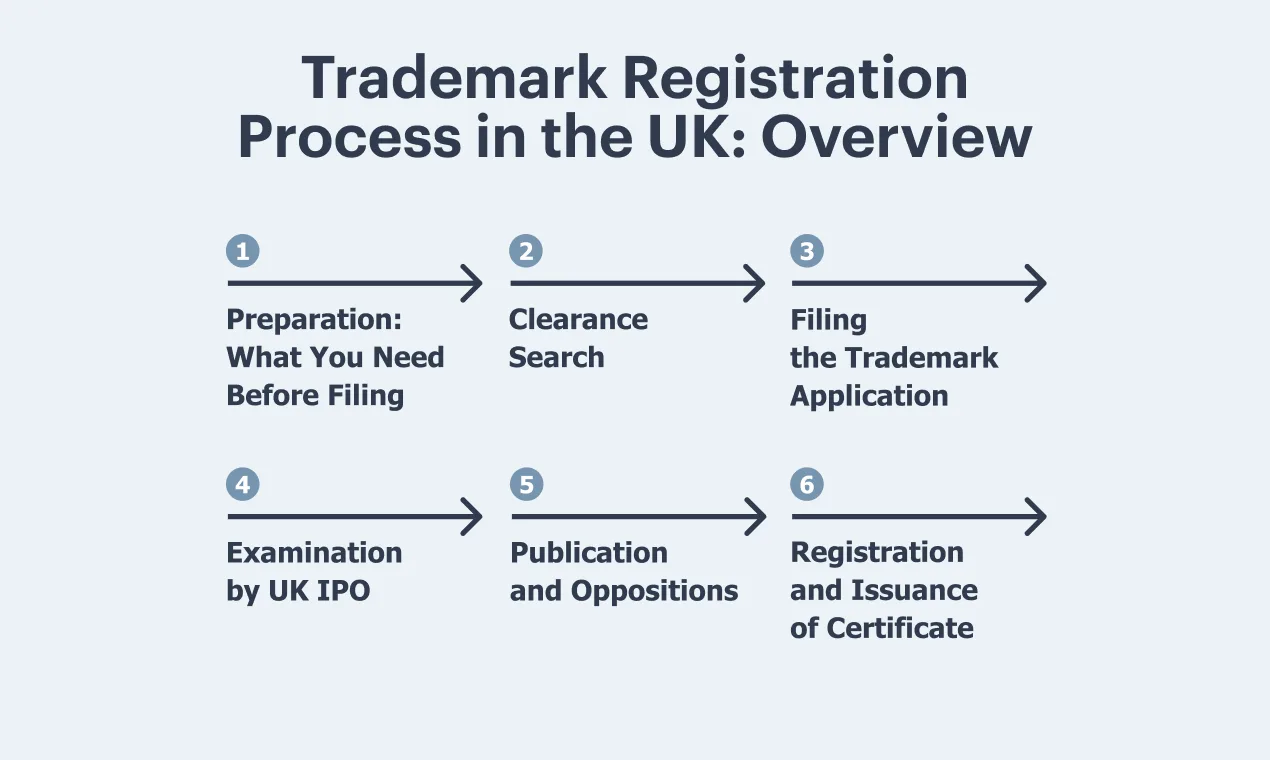
Step 1 — Preparation: What You Need Before Filing
Proper preparation reduces the risk of objections and keeps costs predictable. Before filing you should:
- Define your goods and services
- Decide which products and services you want protection for now and in the next few years.
- Map them to Nice classes.
- Avoid “just in case” classes: each extra class increases government fees and often legal fees.
- Gather documents and files
- trademark representation (word mark or high-resolution logo),
- owner details (full legal name, address, legal form),
- priority documents, if you rely on an earlier foreign filing (within 6 months).
- Plan the budget
- government fees,
- local representative fees (if you use an attorney or need a UK address for service),
- possible translation or additional admin costs (for example, if you later need to assign the mark).
When you work through a platform like iPNOTE, the AI assistant and standard questionnaires help you structure this information in advance and avoid missing elements that later create delays or extra attorney time.
Step 2 — Clearance Search (Trademark Availability Check)
Before spending money on filing, it is important to check whether your mark is likely to pass examination and survive the publication stage.
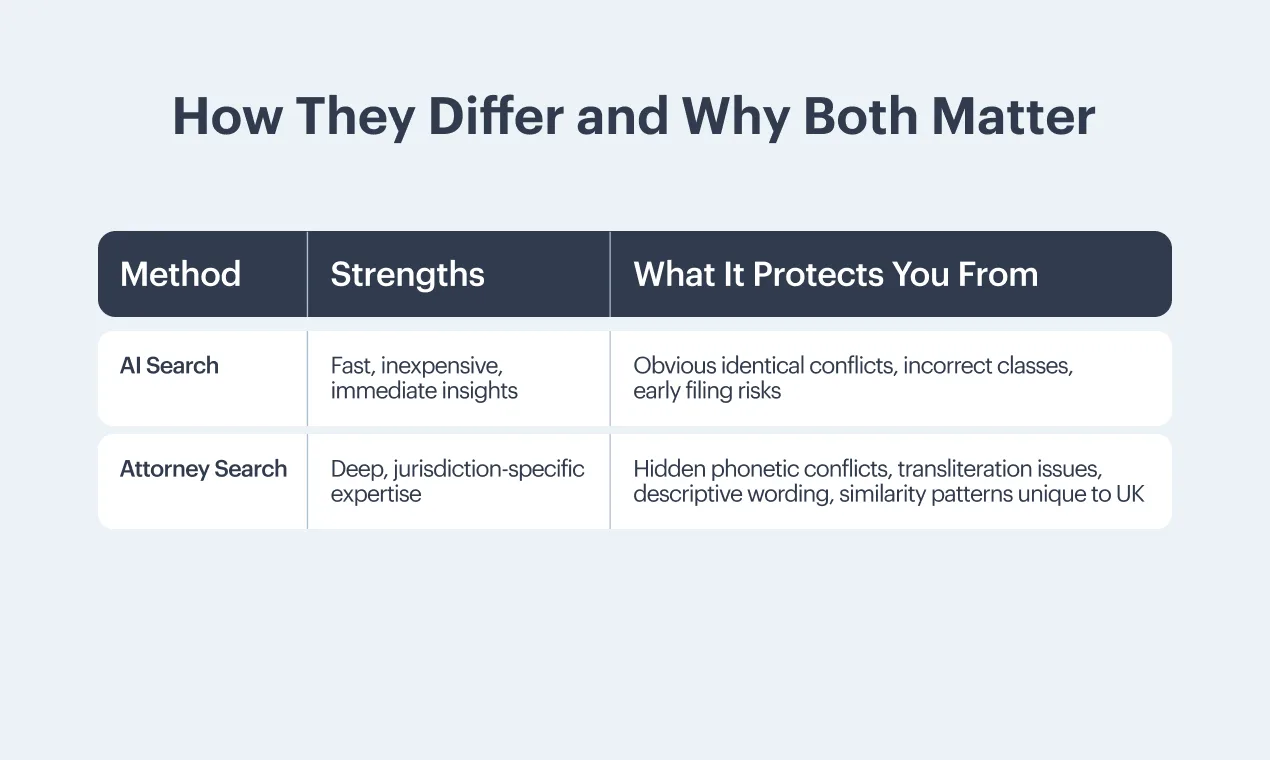
Option 1 — Instant AI Search on iPNOTE
Using the AI assistant, you can get an immediate preliminary analysis of your trademark.
The AI evaluates obvious risks: identical matches, clear conflicts, basic phonetic issues, and overall distinctiveness.
This helps you quickly understand:
- how high the initial risk level is,
- whether it makes sense to file “as is” or adjust the spelling/classes before paying any fees.
Key benefit: You get a fast, objective, automated assessment without spending money on a lawyer at the early stage.
Start your free check with iPNOTE.
Option 2 — Manual search by a UK trademark attorney
A local attorney can:
- analyse similar marks and phonetic variants,
- consider how UK IPO handles descriptiveness and distinctiveness in your sector,
- check related classes where conflicts are common,
- identify potentially aggressive earlier rights owners.
Combining an AI check with an attorney search gives the most reliable picture and reduces the likelihood of an examination report or opposition.
You can request this manual attorney-led search directly through iPNOTE, choosing from verified UK trademark attorneys.
Best Practice
Most applicants combine both steps:
AI analysis for a quick first impression, followed by a professional UK attorney review for a complete, risk-free picture.
Together, these two layers significantly reduce the chance of Office Actions, added expenses, and delays during UK IPO examination.
Step 3 — Filing the Trademark Application
Who can register a trademark in the UK?
Individuals
Any natural person can apply for a UK trademark. Nationality is not relevant — both UK residents and foreign individuals are allowed to file an application.
Legal entities
Both UK and foreign legal entities may register a trademark in the UK. This includes UK companies (such as Ltd, LLP, PLC) as well as foreign companies and entrepreneurs (for example, LLCs, sole proprietors, or their local equivalents from any country).
Overseas applicants
Applicants from outside the UK — both individuals and companies — may file a trademark application directly, without appointing a UK representative, provided they supply a valid address for service in the UK, Gibraltar, or the Channel Islands.
If the applicant does not have such an address, appointing a UK representative (a trademark attorney or IP agent) becomes a formal requirement.
Filing channels
In the UK, trademark applications are fully digital. The standard and fastest route is online filing through the official UK Intellectual Property Office (UK IPO) service. Online filing is available worldwide and is suitable for most applicants.
For those who do not have a UK correspondence address or prefer professional assistance, a UK representative can file the application on their behalf, manage communication with the UK IPO, and handle any procedural issues. A qualified UK trademark attorney can be selected, for example, via a marketplace like iPNOTE, where local representatives are available to support the filing and examination stages.
Filing through iPNOTE: Easy Way to Register in UK
For many applicants, especially those unfamiliar with local requirements, or UK IPO procedures, filing through a platform like iPNOTE removes uncertainty and ensures that every step is completed correctly. The process is transparent, structured, and supported by verified local trademark attorneys.
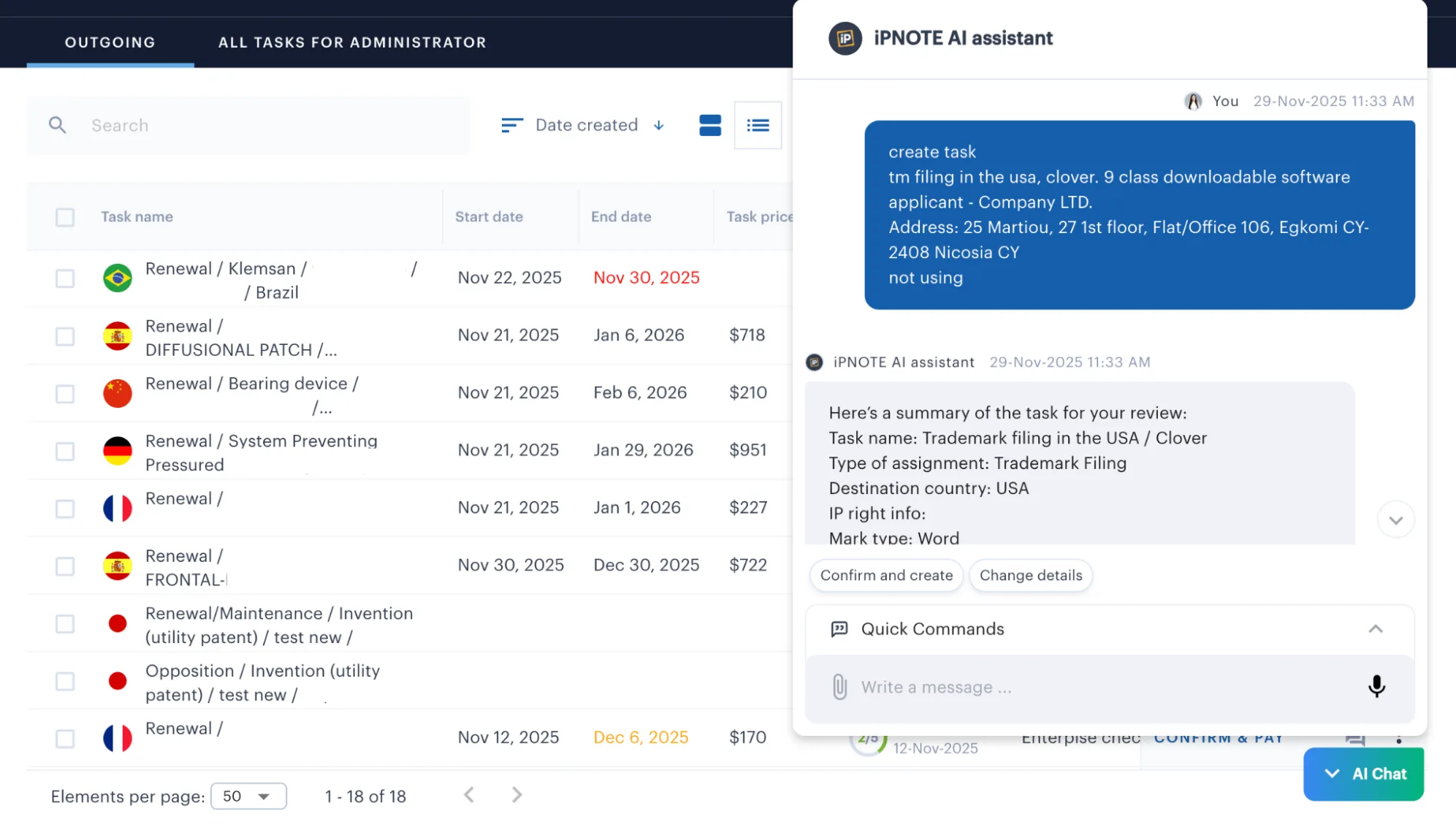
Create a Task for Trademark Registration in UK
You begin by creating a task inside the iPNOTE platform.
The integrated AI assistant helps you structure the request correctly:
- The AI assistant helps you describe your mark and goods/services,
- suggests suitable Nice classes.
Receive a List of Suitable Providers
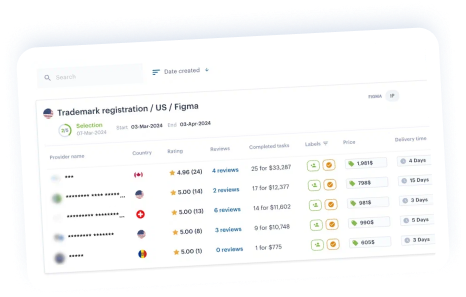
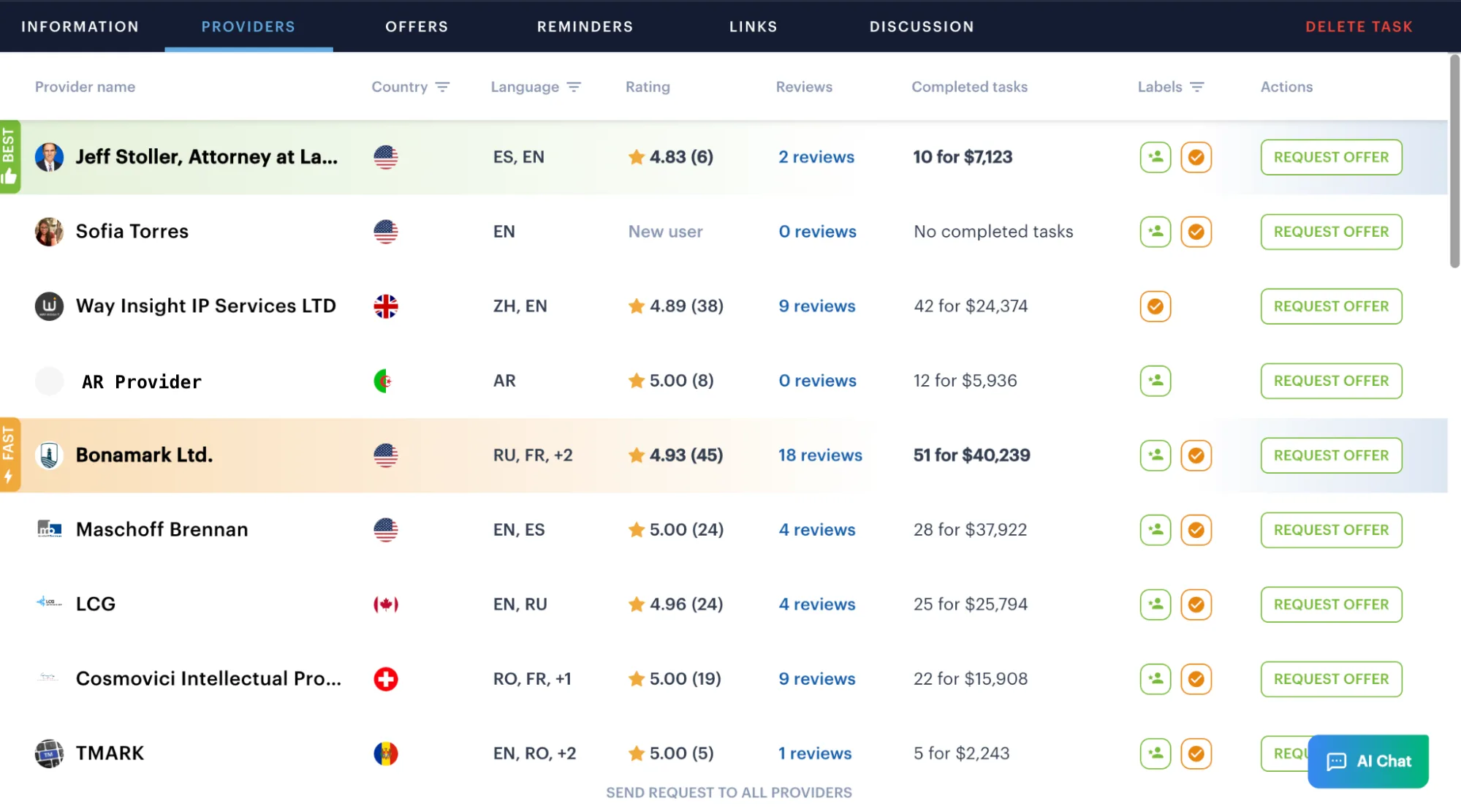
Once the task is created, the platform automatically shows a list of verified local trademark attorneys who can handle your filing.
You can:
- select providers manually, based on their profiles,
- ask the AI assistant to choose the most suitable ones,
- or send a request to all providers at once to compare offers.
Every provider has a complete profile with experience, ratings, response times.
Compare Fixed Offers and Choose the Best Option
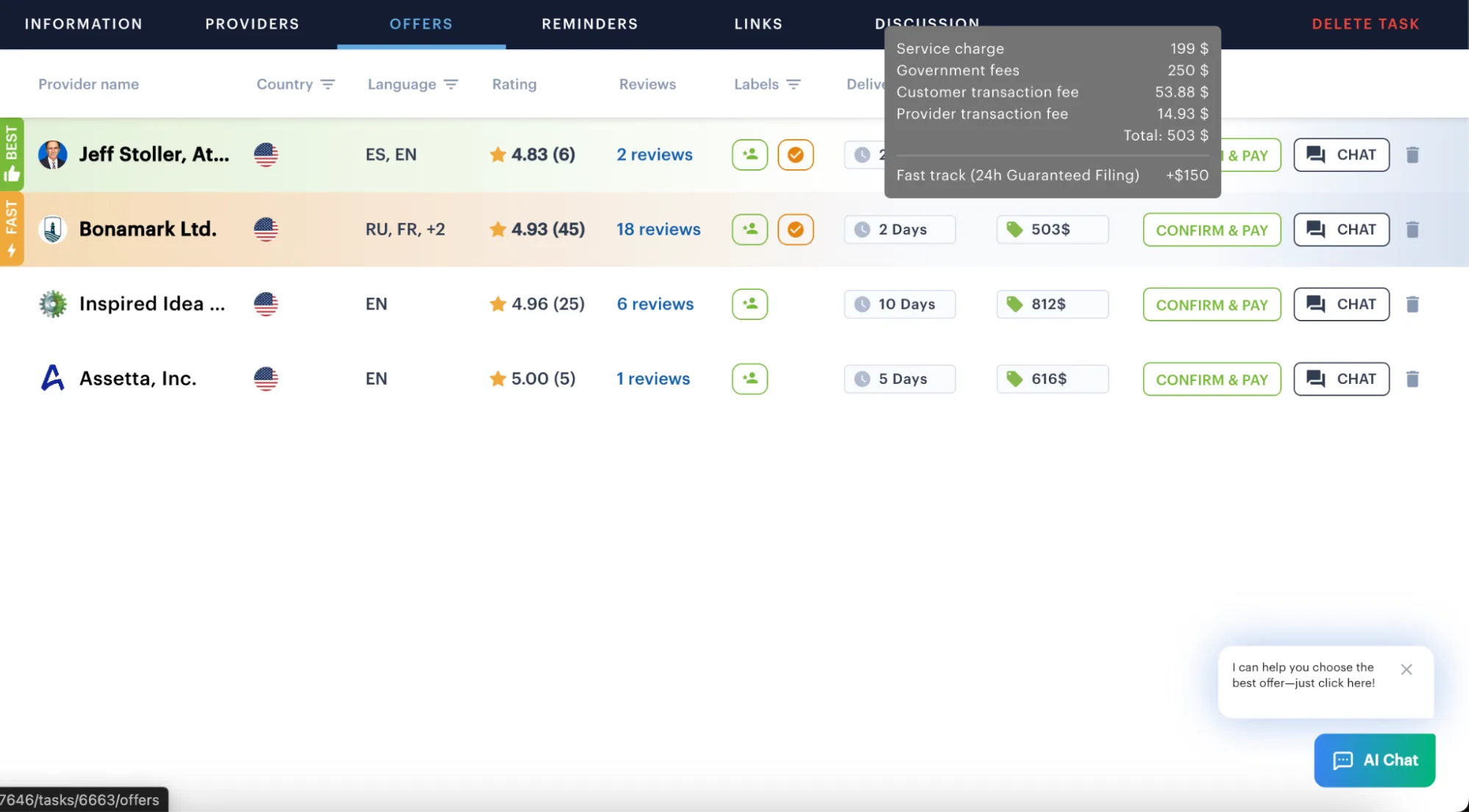
Soon after your request, providers will send their offers.
Each offer contains:
- total cost (including official fees, attorney fees, and the platform commission),
- estimated timelines,
- scope of work covered.
You can also open a chat with any provider in the Messages section to clarify details or ask additional questions. This helps you make an informed decision based on clear, measurable factors.
Pay for the Service — All Fees Included
When you choose the best offer, you proceed to payment.
The price displayed includes:
- UK IPO filing fee,
- representative’s service fee,
- platform commission.
Payment is held in escrow until you approve the result.
The Provider Starts Working Within 24 Hours
After payment, the provider will begin working on your case within one business day if you purchase the Fast-Track option.
iPNOTE uses escrow payments, meaning:
- the provider only receives the funds after you approve the final result,
- the platform acts as a neutral guarantor,
- your investment is protected throughout the process.

Final Review Before Filing
The attorney prepares the application and sends you the final version:
- mark representation,
- goods and services wording,
- owner data,
- priority claim details (if any).
You can review everything in one place and request corrections if needed.
Filing and Tracking Your Application Online
Once approved, the provider files the application through the UK IPO.
After submission, on the platform, in your personal account under the IP Rights section appears:
- application stage,
- filing date,
- application number,
- jurisdiction,
- all uploaded documents,
- communication history.
Statuses update automatically, so you always know exactly where your application stands — without waiting for emails or manual updates.
Step 4 — Examination by UK IPO
In the UK there is essentially a single integrated examination stage that covers:
- formalities,
- absolute grounds,
- search for earlier rights and notification of owners (relative grounds).
- Formal examination
UK IPO checks that:
- the applicant’s details are correctly completed,
- the mark is properly represented,
- the list of goods and services is clear and falls into recognised classes,
- there are no obviously prohibited elements that require consent,
- the official fee has been paid.
If anything is missing or incorrect, the examiner sets this out in an examination report (sometimes called an “office action”).
- Absolute grounds examination
The examiner then considers whether the mark can be registered at all. Typical issues include:
- purely descriptive or promotional wording,
- lack of distinctive character,
- generic terms,
- misleading or illegal elements,
- protected flags and emblems without consent.
If the examiner raises objections, they are also listed in the examination report. Applicants normally have 2 months to reply, with a possibility to request a short extension (commonly an extra month) if more time is needed.
Failure to respond leads to refusal and loss of the filing fee.
- Search for earlier marks (relative grounds)
UK IPO searches its database for earlier UK and international rights and includes potentially conflicting marks in the examination report.
- The examiner does not usually refuse the application solely for this reason.
- Instead, owners of those earlier marks are notified and may later oppose the application during publication.
Because examination reports combine both absolute issues and earlier-rights information, it is important to read them carefully with your representative and decide whether to amend the application or proceed as filed.
Step 5 — Publication and Oppositions
If examination ends without unresolved absolute-ground objections, the application is accepted for publication in the online Trade Marks Journal.
- The publication period lasts 2 months from the date of advertisement.
- Any third party may file an opposition during this period.
- A potential opponent can also file a “notice of threatened opposition”, which extends the period by one additional month (up to 3 months total) to allow negotiations.
If no opposition is filed, the mark moves directly to registration.
If an opposition is filed, the process pauses while the dispute is handled; this can significantly extend both time and cost.
Step 6 — Registration and Issuance of Certificate
Once the publication period ends without successful opposition, the UK IPO proceeds to registration.
- Registration is usually automatic; no separate government registration fee is payable beyond the original filing fee.
- UK IPO issues a registration certificate electronically and updates the status in the online register.
In your IP Rights card on a platform, key data appears:
- registration number,
- issue date (registration date),
- renewal date.
In the UK, a trademark registration lasts 10 years from the filing date and can be renewed every 10 years indefinitely on payment of renewal fees.
Budget: What Trademark Registration Costs in the UK
Trademark registration costs in the UK are more transparent than in many jurisdictions, but budgets still expand when extra classes or professional responses are added.
- Government fees (UK IPO official fees)
Government fees are the only mandatory fees paid to the state. For standard online applications filed directly with UK IPO the current fees are:
- £170 — basic online application fee, includes 1 class,
- £50 — for each additional class.
Examples:
- 1 class → £170
- 2 classes → £170 + £50 = £220
- 3 classes → £170 + £100 = £270
There are separate fees for later administrative actions (for example, changing the owner’s name or address, or recording an assignment), typically £50 per request.
- Local representative fees
If you appoint a UK attorney or representative (which is strongly recommended for non-specialists and required if you do not have a local address for service), you pay professional fees in addition to government fees.
A typical basic filing package for one class often starts around the low-hundreds of USD/GBP range and usually includes:
- preparing and filing the application,
- standard communication with UK IPO,
- monitoring deadlines,
- forwarding examination reports and routine correspondence.
More complex tasks, such as drafting detailed responses to examination reports or handling oppositions, are billed separately and can vary significantly between providers.
- Translations and legalisations
In most UK cases, translations are minimal because the procedure runs in English. However, costs can appear if:
- corporate documents from non-English jurisdictions need to be translated,
- you later record changes or agreements that require certified translations,
- you need advice on non-English versions of the mark.
These expenses depend on the volume of text and the degree of certification required.
- Optional administrative actions
Some actions are optional and arise only if you decide to change details after filing or registration:
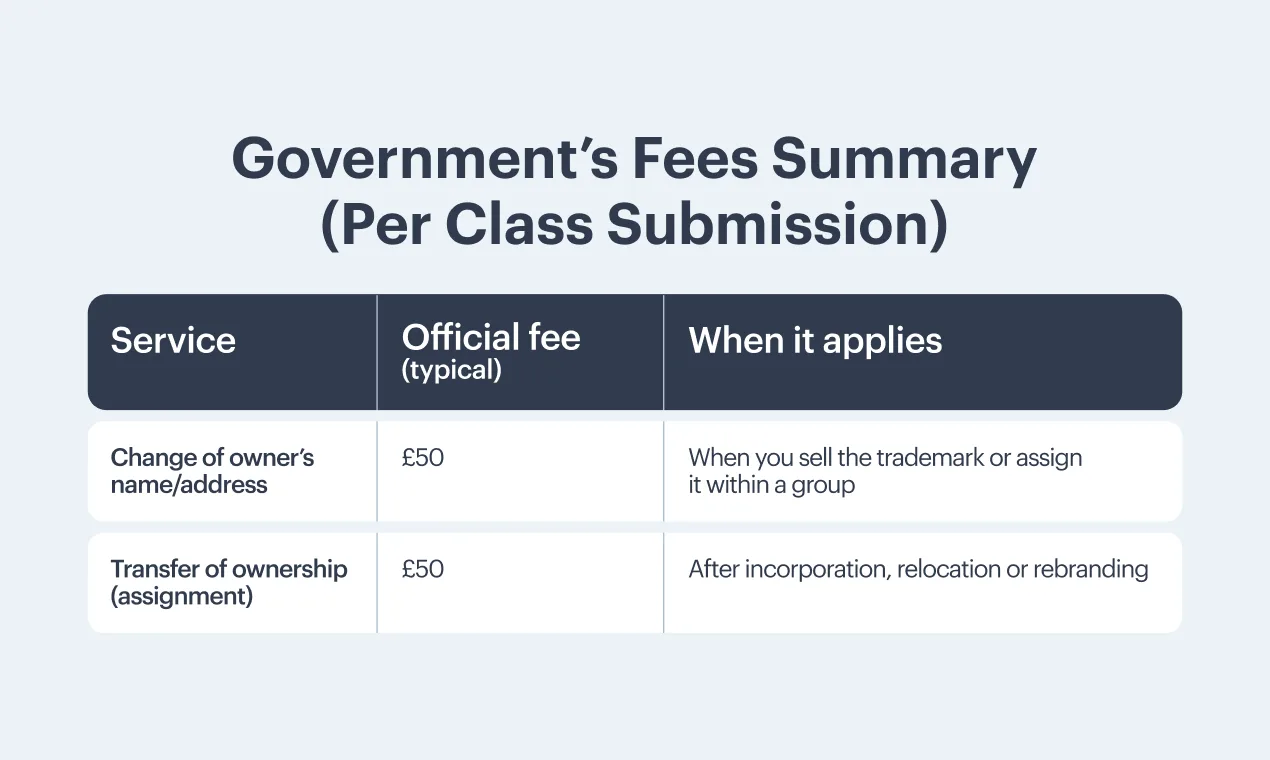
These are not part of the initial registration budget but are useful to keep in mind for later corporate changes.
How to save money
- Choose only the classes you truly need
Since each extra class adds £50, it is easy to overpay by £100–£300 for classes that do not match your real activity. Careful scoping with an attorney or AI assistant often allows you to cover your business in one or two classes instead of four or five. - Use a word mark where appropriate
A word mark often protects the core brand more broadly and avoids additional filings when you refresh your logo. Every unnecessary new application costs at least another £170. - Invest in a clearance search
Objections and oppositions cause delays and add professional fees. A good pre-filing search helps you avoid obviously conflicting marks and reduces the chance of needing a second application. - Work with verified representatives through a platform
A marketplace of vetted UK attorneys with fixed offers reduces the risk of hidden extras, limits translation costs, and helps you receive UK IPO-style wording from the start, which cuts down on corrections and examination reports.
Timeline: How Long Trademark Registration Takes in the UK
Compared with many jurisdictions, the UK process is relatively fast. If there are no objections or oppositions, registration can be completed in around 4 months from filing.
Below is a realistic breakdown of each stage.
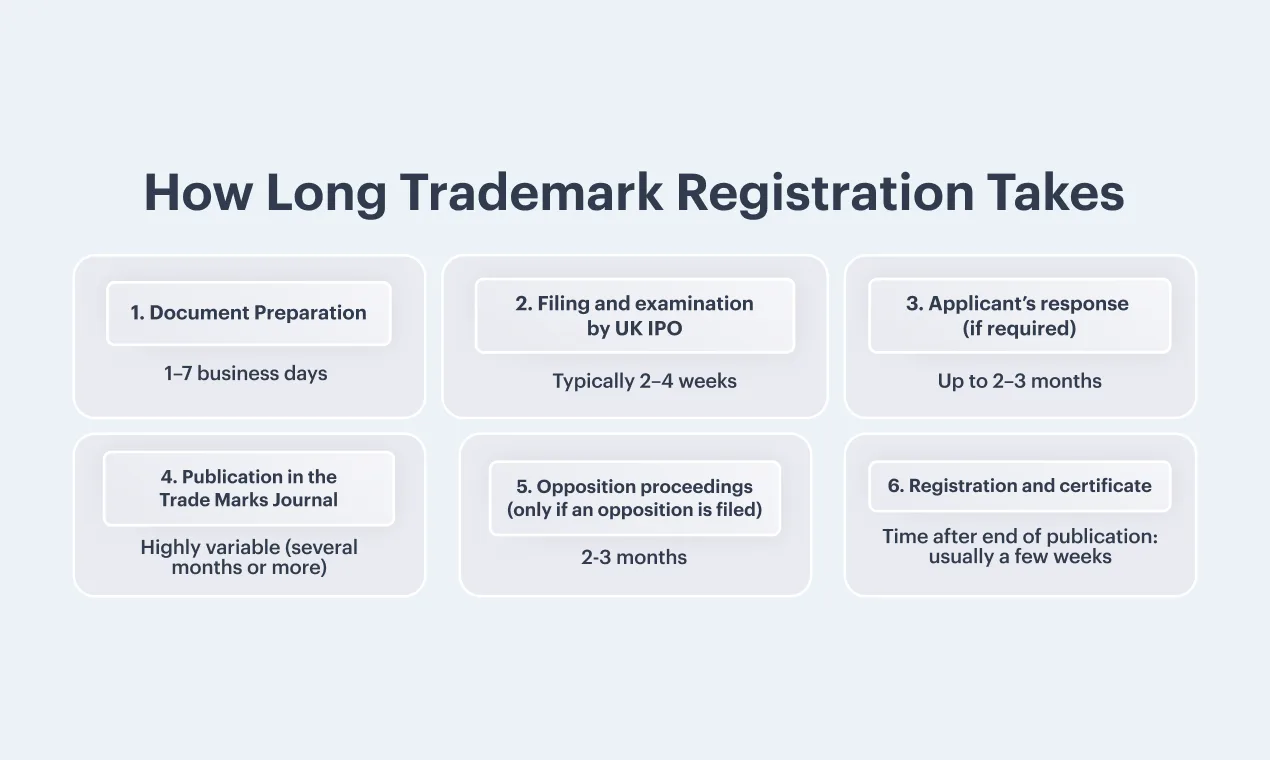
1. Document preparation
Time: 1–7 business days
This depends on how quickly you:
- finalise the list of goods and services,
- gather owner details,
- prepare the mark representation,
- agree the filing strategy with your representative.
2. Filing and examination by UK IPO
Time: typically 2–4 weeks until the examination report is issued, sometimes up to 2 months during busy periods.
UK IPO checks formalities and absolute grounds and performs the search for earlier rights. The result is the examination report.
- If there are no objections, the mark moves directly to acceptance and publication.
- If there are objections, you usually have 2 months to respond, with a possible short extension if requested.
3. Applicant’s response (if required)
Time: up to 2–3 months including preparation and UK IPO’s follow-up review.
The overall duration of this step depends on:
- how complex the objections are,
- whether you need to amend classes or wording,
- how quickly your representative prepares the reply.
4. Publication in the Trade Marks Journal
Time: 2 months standard opposition period, extendable to 3 months if a notice of threatened opposition is filed.
During this time:
- the mark is visible on the UK IPO website,
- any third party may oppose.
If there is no opposition, registration is straightforward.
5. Opposition proceedings (only if an opposition is filed)
Time: highly variable (several months or more).
Oppositions involve pleadings, evidence and sometimes hearings. They are the main cause of prolonged timelines and increased cost.
6. Registration and certificate
Time after end of publication: usually a few weeks.
If the mark is unopposed or an opposition is resolved in your favour, UK IPO registers the mark and issues the certificate.
Conclusion and Next Steps
UK trademark registration becomes easier to manage once the structure is clear: fixed government fees per class, professional services where they add value, and additional costs that appear only in specific situations (such as oppositions or ownership changes). When every stage is visible, the budget stops feeling unpredictable.
Using a platform like iPNOTE, you can upload your trademark, let the AI assistant help with classes and an estimated budget, and then compare fixed, itemised offers from verified UK attorneys. You see exactly how much goes to UK IPO and how much covers professional work, before you commit.
If you want transparent pricing, clear timelines and ongoing control in one place, create a full-service UK filing task on the platform and see what your trademark registration will cost end-to-end — with no surprises along the way.